The Bitter Script Reader comes from the perspective of a Hollywood script reader who's tired of seeing screenwriters make the same mistakes over and over. It's a fun yet quite informative blog. This is from a recent post entitled: What Makes You See A Movie?:
A writer trying to sell his screenplay is often asked "Who's the target audience for this?" Now, it's easy to hear that question and fly into a rage over how horribly commercialized Hollywood is, with films not seen as art, but commodities designed to sell stale popcorn and salty pretzels. However, all the statement means is, "Who will see this? Who will want to see this? What viewer will this film reach?"
Check out the comments...you'll be surprised by some of the reasons given.
I tend to divide theatrical releases into two categories: movies and films. 'Movies' should be experienced at the local cinema, whereas 'films' can be enjoyed at the local Cineplex OR in the comfort of my own home. And speaking personally, I'll be swayed by films brought to us by certain writers, directors, and/or filmmakers...stars, not so much anymore (you burned me one too many times DeNiro!), and movies that demand being seen on the big, or a bigger at least, screen. Thus I've stood in line to watch Transformers or Wanted as opposed to The Reader or Revolutionary Road, even though I know darn well the latter two will be much better "films". And as for commercials and trailers, they've become more of a turnoff than a draw for me of late due to their tendency to expose pretty much the entire plot. A clever poster can actually be more seductive and enticing.
Anyway, having a sense of who will want to watch your film and why is really important to know when you're writing your screenplay. Duh. But it's a question a lot of screenwriters never seem to get around to answering until it's too late, especially up here in Canada.
I don't have much else to say other than Disney/Pixar'sUp took me up, up and away. Dazzling, stunning, moving, touching...a deft blend of whimsy and poignancy, heartache and life-affirming spirituality...if you're an adult you really don't need the 'just taking the kids' excuse to see this movie (though that was my excuse).
I was impressed by pretty much every aspect of Up, but what especially won me over was the score composed by Michael Giacchino. Listen to 'Married Life', an early piece that underscored a beautiful five minute 'silent sequence' sans dialogue, and established the recurrent musical medody that reverberates from beginning to end:
Later in the film, under another 'silent sequence', Giacchino performs a sparse, sad version of the above tune...which gave me the opportunity to explain variations on a theme in film scoring to my youngest daughter after she exclaimed: "Hey...that sounded the same as before, but different!"
The simple marriage of this melancholy melody with these two very different yet dramatic sequences was so emotionally pure in its aching sincerity, I was genuinely moved while watching...at a cartoon no less!
Oh, and in case I've got you thinking it was all drama all the time... the talking dog with the high squeaky voice killed.
A repost...since this film was released on DVD yesterday. And though I stand to gain absolutely nothing by pushing it, when I thought back through the comedy movies I saw last year, Role Models still stood out as my favourite.
So, like, go rent it if you haven't seen it...
Saw Role Models a couple nights ago with the teenage daughter, and even though I experienced slight discomfort when boobies were flashed on screen (is there ever a time when watching sex and nudity in movies with your children isn't awkward?), we both enjoyed it immensely. Paul Rudd is snide but sweet, Seann William Scott is simple but solid, and the supporting cast delivers big time.
Lowbrow funny with lots of heart, it's got a kind of 'School of Rock' meets 'Clerks II' feel. Even though this trailer makes it seem like a PG Disney flick, this R-rated trailer tells it like it is.
EDIT: I've been advised that if I'm going to be plugging worthwhile rentals of the week, I should also mention Charlie Kaufman's Synecdoche, New York (review HERE and trailer HERE) and the 'un-vampire movie' Let The Right One In (trailer HERE).
Check them all out...I'm betting you'll be pleasantly surprised.
I'll admit I got nothing this week....no interesting thoughts worth expressing...no brilliant or even not so brilliant bits of wisdom at the top of the brain --- no posts leaping to mind at all.
So instead I'm taking a moment to marvel at the genius that was Coppola...and trying to even grasp making The Godfather, The Conversation, The Godfather Part II, Apocalypse Now, and One From The Heart in a nine year span during the mid/late '70's.
Waits + Gayle + Coppola. It was such a visual and musical feast, yet so overlooked and underrated...
The opening:
And the closing...
Not a perfect movie by any means, but still....wow. And it's melancholy mood accurately reflects the prevailing winds round here these days.
For those feeling a little blue, or the pinch of a battered economy, or especially those in our business getting laid off of late...I'm sorry.
Yesterday was a brief overview of scary movies....today, some soundtracks that helped make those movies even scarier. And not surprisingly, a lot of the most haunting or unforgettable scores are from a lot of the same films.
First rule seems to be LOTS of minor keys...major notes or chords, not so much.
Next, refrain from resonance...add plenty of dissonance.
Then bring on the cacophony...leave the harmony on the shelf.
And finally, a LOT of repetition...drilling it into your head over and over...this is scary...this is scary...this is scary...
As for classic horror movie soundtracks, there's the obvious ones..John William's Jaws... the theme from The Shining... Bernard Herrmann's score from Psycho...Mike Oldfield's theme from The Exorcist... Krzysztof Komeda's score from Rosemary's Baby ...Jerry Goldsmith's The Omen ...
But even though clearly influenced by Oldfield (in the case of Halloween) and Berrmann (in the case of Friday the 13th), for me the two most memorable have to be from the 'original' modern slasher films...
John Carpenter's theme for 'Halloween':
...and Harry Manfredini's theme for 'Friday the 13th':
Saw V did over 30 million at the box office this weekend, proving once again that public appetite for such 'horrific' fare still reigns supreme, especially when All Hallows Eve approaches. Also in the spirit of Halloween, my tweenage son and I watched Will Smith's I Am Legend on Friday night.
Bad idea.
Now I am old and jaded, so it didn't do much for me (not to mention an abundance of CGI which, however well it's done, always tends to push me out of a movie as opposed to draw me in), but it freaked my son out. A lot. He's since woken up from nightmares, and when awake hasn't stopped talking about it - ("...what if world got wiped out by virus?" "...what if a virus turned us into flesh-hungry zombie-like creatures?"). What if. What if. Gak.
I will admit I'm feeling a little guilty for subjecting him to it (even though he was the one who said: "Let's watch something scary!")
"I Am Legend", like most contemporary horror films, isn't 'original'. The story is adapted from a 1954 sci-fi novel by Richard Matheson, which has been filmed twice before, as "The Last Man on Earth" (1964), and "The Omega Man" (1971) starring Charlton Heston.
And I do remember "The Omega Man". Oh yes. It freaked me out when I first saw it...probably around the same age as my son is now. And like him, I didn't even see it in a theatre but on late-night television, and it still freaked. Of course, checking it out now, it seems pretty cheesy...but way back when...Omega Man...."shiver".
Sticking with when I was younger, the two movies constantly referenced as well-made pictures that also managed to scare the crap out of the audience were "The Exorcist" and "Psycho".
No argument here...but when I eventually saw them, I'd either heard too much already or my expectations were too high, and I felt let down. I wasn't 'fugged up'.
"Jaws", on the other hand, freaked me out quite a bit, but most wouldn't really categorize it as a horror movie. The first "Halloween" and "Friday the 13th" and "A Nightmare on Elm Street" all had their moments, but they were just good candy-coated popcorn...tasty in the moment, but generating very little of the residual 'wake up screaming covered in sweat later that night' factor.
No, the two that really did it for me it were John Carpenter's "The Thing" (1982)...
...and "Alien" (1979).
I suppose one could debate whether they are 'horror movies' in the classic sense as well, but I would say so. At their core they're 'trapped in the house with a monster' movies...relentlessly suspensful and tension-filled...and they accomplished horror's highest grade - they scared the bejesus out of me.
More on contemporary horror later this week, but now that you've read this far --- scariest horror films ever?
Thanks much to John August for his very informative yet terribly sobering wrap up to his journey that was The Nines. And because his feature directing debut and its subsequent theatrical/DVD release was so firmly rooted in the world of the small independent film, thus making it like pretty much all Canadian feature films, I thought it worth excerpting some of Mr. August's wisdom.
A quote from Mark Gill in the LA Times last week would seem discouraging for independent filmmakers:
Of the 5,000 films submitted to Sundance each year — generally with budgets under $10million — maybe 100 of them got a U.S. theatrical release three years ago. And it used to be that 20 of those would make money. Now maybe five do. That’s one-tenth of 1%. Put another way, if you decide to make a movie budgeted under $10 million on your own tomorrow, you have a 99.9% chance of failure.
There are lots of ways to criticize his logic. For starters, most Sundance movies are way under $10 million. Many are under a million. And he seems to omit a figure for how many indie films are getting a theatrical release now as opposed to three years ago.
We need to ask, “Failure for whom?” Even a movie that doesn’t earn its budget back will likely make money for its distributors, once you factor in video and TV sales. More crucially, a good indie film generates future work for its stars and filmmakers. So there’s a lot of success to be found in that 99.9% failure.
All that said, he’s kind of right.
He's kind of right...shiiiit. That's some bad odds. August goes on to say that his movie turned out just the way he wanted, but the release of the movie was deeply disappointing. Thankfully though, he doesn't do a lot of finger pointing but instead lists several crucial stages in the The Nines release, from Sundance screenings to the DVD hitting the shelves, and then explains what he might have done differently at each stage vs. what actually went down.
Take Sundance for example --- August lists all the other films in addition to his that had buzz when he was there, and then lays out how they ultimately performed.
Eighteen months later, it’s fascinating to see how little the festival buzz mattered. Prices for these movies — a key component of buzz, as in, “Did you hear how much it sold for?” — were all over the board, from the low six-figures to $7 million for Son of Rambow.
But it made no difference. They all pretty much tanked.
Waitress sold quickly, was released quickly, and made the most by far at the box office ($19M).3 Second place was Under the Same Moon ($12.5M), followed by Once ($9M) and How She Move ($7M). Son of Rambow will likely end up in fifth. It’s currently in release, and made $8M overseas.
In terms of box office, none of these are hits in the way Little Miss Sunshine was. But you’d be happy being any of them, because beyond those five, the other movies on the list fell off a cliff. None of them made a million. In fact, most didn’t make it over $100,000. The Nines didn’t, despite opening well.
But at least we opened. At least we sold. For our year, 3,287 feature films were submitted to Sundance, of which 122 played. Roughly 20 played in theaters.
Wow. That's some kind of seriously depressing numbers game going on. And here I was last week criticizing Canadian release Young People F**king for only mustering up around a 300,000 gross over the past month (this considering all the free publicity surrounding the film and Bill C-10) ...but damn, perhaps I was a little harsh.
Or maybe, as August says later in his post, "(for the small independent feature)...theatrical release is kinda bullshit."
I get a lot of questions every year from students or up and comers about why does the Canadian feature film biz suck... or why aren't more Canuck features in theatres... or how easy or hard is it to make a low budget feature film... and the takeaway is it's really f**king hard for everyone. And then you have to try to get people to see it, which in many ways can be even harder than making the damn thing.
Thanks for sharing John...the post in all its honest and straightforward entirety is entitled 'Sundance, The Nines, and the Death of the Independent Film', and you can read it HERE.
Been having some strange dreams lately...don't ask me why. You know, dreams that sear your brain, take root there, and then continue to fester and grow the next day. But sometimes those 'dreams' can serve as inpiration...which got me thinking about disturbing movie scenes and sequences.
A lot of my faves come from my youth...when one was relatively unscarred by all the horrors the real world had to offer so being exposed to a dark twisted movie sequence could really do a number on you...like almost any scene from the original Texas Chainsaw Massacre, or Andy Warhol's Frankenstein, or Taxi Driver, or even Marathon Man's 'Is it safe?' scene...
But let's dig deeper, darker. Some standouts...Reservoir Dogs and the ear trimming set to 'Stuck In The Middle With You':
Or in Trainspotting...the toilet scene (or dead baby scene, take your pick):
But the master of the disturbing scene (but not necessarily effective film) is still, for me, David Lynch. From Elephant Man to Twin Peaks to Wild At Heart to Lost Highway, his movies have always been flawed but laden with memorably messed up moments (Fire Walk With Me...shiver). For example, Dennis Hopper's Frank in Blue Velvet and the "Mommy wants to f***!" scene made me shit...though for some reason, Dean Stockwell lip syncing 'In Dreams' disturbed me more:
Or who could deny the creep factor of Robert Blake's "I'm in your house right now. Call me." request of Bill Pullman in Lost Highway:
Or the diner scene and the man's recounting of his dream in Mulholland Drive:
Dreams are where Lynch really plays with our heads: all of his films have them...but the movie of Lynch's that remains to this day the only film I've ever walked out of (because it just creeped me out so) was Eraserhead. Essentially one long bad dream, it was an experiment in the juxtaposition of grating industrial noises and some horrific images (monster baby anyone?):
I've tried watching some of today's gore porn like the Hostel movies and Saw sequels, but they tend to either sicken or repulse or just bore with their blatent graphicness. It's all on the surface, and doesn't get under your skin. Unlike say, Donnie Darko and the rabbit skull. Or the General in Pan's Labyrinth having his cheek sliced open and then sewing it up himself. Or even the restrained threat of Anton the psychopath in the new Coen Brothers movie...that scene in the gas station with the old man and the coin toss...now that was disturbing.
I've written a lot of TV scripts, but the ones that remain 'memorable' in most people's minds have been the ones with unsettling yet relatable scenes. One was an Are You Afraid of the Dark? where two teens in a dingy ventured out onto a haunted swimming pool with something dangerous lurking beneath the water (Jaws in a pool was my pitch I believe). Another was a Psi Factor episode where a young man who we weren't sure if he was alive or dead began slowly decomposing and started peeling off his fingernails one by one. Both have earned me far more compliments than other episodes I was more proud of, because they had memorably disturbing sequences.
I've talked about this before...'movie moments' in the TV script. If you're writing horror or suspense television, try to go to that dark place of your nightmares and see what you find...sometimes one good creepy sequence is all you need to build your story around.
Last week I was enjoying Michael Clayton in the darkened comfort of the local Galaxy cinema, when I witnessed a '(movie) moment'.
It's dawn, and George Clooney (Clayton) drives quickly down a country lane when, without warning, he pulls over to the side of the road. On a nearby hillside he notices three unsaddled horses standing at attention. Clayton thinks a moment, then carefully exits his vehicle and walks across the field until he stands right before the three animals. The sun starts to rise...the misty fog starts to evaporate. Clayton's face is a twisted mess of guilt and remorse...for what's he's done with his life, and what he hasn't done. The music quietly builds and swells. The camera slowly circles him and the horses. And we feel his pain and sense his disconnect and despair. (Next, in the background, his car suddenly explodes...but it's merely the button to the moment I'm describing)
Why was all of this a moment? Because it was written and directed with a primary goal of invoking an emotional response in the viewer, and it took its time doing so. It 'breathed'. It also paid explicit attention to 'getting the details' of the scene, and, not surprisingly, would've taken a good chunk of a day (or two) to film.
EDIT: Just let me add this as I fear I may not have been clear. The explosion isn't the moment I'm trying to describe....it's simply the conclusion of the sequence of Clayton leaving his car to square off against the horses. That sequence is the moment...a series of shots, usually with no or little dialogue, that make you the viewer 'feel' something. I 'felt' whatever Clayton (Clooney) was going through at that 'moment', as it were.
Feature films, or at least the good ones, usually have several of these throughout the movie....and they can, because they have the time and budget to do so.
TV? Not so much.
When making television, shooting schedules are fast and furious, and you're fighting the clock every minute just to make your day, much less 'create' any movie magic. Not to mention there's expectation of a certain pace and energy to network television drama when it airs (I'm excluding cable and premium pay channels for now as they tend to have a movie/TV hybrid in their look, style, and execution) that demands you keep the story moving. The prevailing network exec notion seems to be if you try to slow it down and let the moments breathe, the viewer will just click away.
But why? Those moments are the ones that tend to stick and make an impact on the viewer, both intellectually and emotionally. They 'move' people...and are fun to make and watch because they're usually done by showing, not telling (as in, sans dialogue).
But TV's so much about the telling.
Still, today's shows have tried to manufacture their version of the moving movie moment...you know what I mean, the closing scenes set to some popular song where we generally see all the characters in some form of 'reflective' moment or situation. Except it's really more of a montage than a 'moment', and tend to feel manipulative instead of honest. And it may not necessarily go where it would be most effective dramatically (as in the ending's not always necessarily the best place). In a nutshell, it's not the same thing.
TV drama could use more 'moments' more often, in my opinion. And any TV director worth his or her salt should try to weasel in a few into every TV episode they work on. This even though the machine will fight you every step of the way (the shooting schedule will kick 'moments' out quicker than you can say Action!, with A.D.'s and line producers marching up to you waving your shotlist over their head: "Are you nuts? We don't have time for this?"). But fight back a bit and make some time, even if for just one short sequence...
...and maybe we'll see more (movie) moments, on TV.
I hate it when a columnist crystallizes a thought I was mulling. I feel usurped or beaten to the punch somehow (though I have no reason to...it's not like I'm blogging for a living). You see, last week I was pondering a lot of the fav suspense American films of my youth....movies like The French Connection; Klute; Chinatown; The Conversation; Three Days of the Condor; The Parallax View; Fingers; Taxi Driver; and my all-time faver...All The Presidents Men.
It probably had something to do with me recently finishing reading Peter Biskind'sEasy Riders, Raging Bulls...a wonderful overview and analysis of the American film renaissance of the 1970's. It's the kind of book that lets you come away with sound insight into how today's theaters have come to serve up such dumbed-down drek -- and nostalgia for an eternal Golden Age.
And all the while wondering...why doesn't Hollywood make movies like that anymore?
Then along comes Tony Gilroy and his latest, Michael Clayton, which manages to be very contemporary yet feels like it could be dropped seamlessly into the middle of the above mentioned classics. A character study and morality play neatly wrapped in the paranoia of a corporate conspiracy.
But before I could blog anything, the Washington Post's Ann Hornaday puts out a nice piece on Gilroy (Bourne Supremacy; Bourne Ultimatum) and his new film.
As subtle and unflashy as "Michael Clayton" is, it feels both nostalgic and incredibly fresh, reminding viewers that movies weren't always about fireballs, flatulence and merch-friendly franchises. Many viewers will no doubt walk out of "Michael Clayton" not just puzzling over its plot twists, but wondering why so many movies in the '70s were this good, and why so few today are. "The audience [then] was tuned up for that kind of movie," Gilroy says. "That's what people expected when they went to the movies."
Gilroy chalks the '70s heyday up to two forces dovetailing to fortuitous effect. "As you're coming out of the '60s, everything's up for grabs," he explains, referring to the cultural and political ferment that found expression in Hollywood in the 1970s, from the antiwar allegorical satire "M*A*S*H" to such laconic, often provocative urban thrillers as "The French Connection," "Klute," "All the President's Men" and "Taxi Driver."
Gilroy goes on to say how he had to change what he's known and gets paid very well for in order to write Michael Clayton:
For Gilroy's part, the desire to resuscitate the cinematic values of his youth meant changing habits he's honed over 20 years as a successful screenwriter, most notably of the "Bourne" movies starring Matt Damon. Out with the on-the-nose, direct and obvious, and in with the elliptical, implied and oblique.
"I had to fight a little bit against the things I'm most rewarded for doing," he explains, adding that as a screenwriter "you're really rewarded for buttoning up scenes, you're paid very well for having everything tidy. You don't even know how and why you learn the things you learn, it's sort of positive reinforcement. So a lot of the scenes in this film are the scenes that are exactly not the moments that you put in the other thriller. It's sort of like the bizarro-world thriller, in a way."
Good on him, though I do think he's selling himself and the Bourne movies short. Personally, I liked them a lot. Still, it's not like any of this means any new renaissance on the horizon. Too much money at stake. Hollywood is what it is now...and films like Michael Clayton and The Nines the upcoming We Own The Night will be the anomaly instead of the norm.
But go read the article anyway...and for what it's worth, I would've said the same thing.
I always go around the room at the start of each semester and ask my college students what TV they're watching and what movies or moviemakers they're digging...
In this class, preferences were all over the map, but the winners for TV seemed to be The Office and Arrested Development (both comedies, it should be noted). And I heard some praise for moviemakers Scorcese and Tarantino, but Wes Anderson appeared to triumph.
I like this choice.
Fact: even though I'm old by comparison, I also dig Wes Anderson, and would put the trilogy of Bottle Rocket, Rushmore, and Royal Tenenbaums on a list of my favourite movies from the past ten years. Fact: his new film, The Darjeeling Limited, opens in a couple weeks. It appears to be another interesting meets quirky affair. Fact: Rolling Stone magazine gushes loudly...here's the trailer:
Looks good. It just made my list of things to do the day it opens. Hope 'the kids' approve.
To learn something of interest in TV/Media, check out this article in Business Week about a new device that monitors which ads people skip and which they watch or at least absorb when using TiVO.
What has marketers scratching their heads is that so many of the winning campaigns are direct ads, like CORT's (Furniture Rentals). Ask execs at some top-flight creative agencies (who are responsible for some big-budget, glitzy Super Bowl ads), and they'll launch into the type of spin used by oil companies when they say more study is needed on global warming. (One exec asked me: "Do we know that this machine accounts for when people fast-forward but then rewind to watch the ad?") If there's one lesson learned from TiVo StopWatch, it's that relevancy outweighs creativity in TV commercials --- by a lot. The ads on the "least-fast-forwarded" list aren't funny, they aren't touching, and they aren't clever. And they don't have big budgets.
Before you know it, we're not only seeing shows set in the 50's (a la Mad Men), we're gonna see TV ads looking like the 50's again ('cept no one will be smoking, of course)...that's news, isn't it? (And that's only a line that could come from an ad exec).
And to kill some time, go peruse this list of the 100 Greatest Film Directors over at the Total Film website. 100-51 IS HERE; 50-1 HERE.
The entire list is a nice stroll down film school memory lane -- some bang on (Coppola in the top 5) and some big huh's? (Alan J Pakula way down at 93?!), with the top three being Spielberg, Scorcese, and of course Hitchcock takes the number one spot.
See if you can match the quote to the director:
a) “Growing up, I saw power exercised in two ways: the power of the church and the power of the street.”
b) "Some films are slices of life, mine are slices of cake.”
c) “I always like to think of the audience while I’m directing. Because I am the audience.”
Music documentaries have always held a special place in my amp (I must've watched every one of VH1's Behind The Music), but they need to be divided into two categories...
1) rock docs that look back at an era or movement or artist and provide an overview with perspective (a la Scorcese's No Direction Home about early Bob Dylan, or this magnificent 10 part UK rock doc series entitled The Punk Years (watch it HERE));
2) and then those rock docs that were immediate and fresh off them happening (a la Decline of Western Civilization or The Rolling Stones C*cksucker Blues)...a slap to the face and punch to the gut visceral sort of experience.
My vote goes to Dig! (watch the trailer) - the fascinating story of two west coast American retro bands, the Dandy Warhols and Brian Jonestown Massacre, told over seven years through the late '9o's and early 2000's. The film deftly chronicles each bands subsequent rise and/or fall framed around the friendship/rivalry between the two lead singers...the Dandy's Courtney Taylor and Massacre's Anton Newcombe (with his tambourinist 'Joel' making a memorable turn).
Best rock n' roll documentary ever. I'm still not sure why this flick struck such a chord with me, but it did. Perhaps because it so effectively portrays the constant struggle between art and commerce in the recording industry (or any creative endeavour for that matter) while being sad, funny, and entertaining all at the same time. And it contains some of the coolest music you'll ever hear by people you've never heard of. Furthermore, the two disc DVD has nearly eight hours of extras that prove to be as interesting and entertaining as the movie itself.
Jack Lipnick: We're only interested in one thing, Bart. Can you tell a story? Can you make us laugh? Can you make us cry? Can you make us want to break out in joyous song? Is that more than one thing? Okay!
When asked what I felt was the best movie about writing and being a writer, my first answer was it had to be Barton Fink, the Coen Brother's surreal exploration of a tortured playwright cum screenwriter's soul (played by John Turturro).
Barton Fink: I gotta tell you, the life of the mind... There's no roadmap for that territory... And exploring it can be painful.
But then I remembered...
Charlie Kaufman: To begin... To begin... How to start? I'm hungry. I should get coffee. Coffee would help me think. Maybe I should write something first, then reward myself with coffee. Coffee and a muffin. So I need to establish the themes. Maybe a banana nut. That's a good muffin.
Could I really exclude Adaptation, Spike Jonze and Charlie Kaufman's surreal exploration of a tortured screenwriter's soul (nicely played two ways as twins by Nicolas Cage)?
Charlie Kaufman: The script I'm starting, it's about flowers. No one's ever done a movie about flowers before. So there are no guidelines... Donald Kaufman: What about "Flowers for Algernon"? Charlie Kaufman: Well, that's not about flowers. And it's not a movie. Donald Kaufman: Okay, I'm sorry, I never saw it.
I'm torn. Are these the best movies ever about writing and being a writer? Or are there others that should be considered.
"Does a man possessed of true artistic genius create his own moral universe?"
In keeping with Comedy Week, and inspired partly by some comments scattered around the net, let's look back at Woody Allen's movies.
Several of the titles that popped up as people's favs prompted surprise..."Stardust Memories", "Crimes And Misdemeanors", "The Front" (a film Allen only performed in)...when we're all used to hearing the usual suspects: 'Annie Hall', 'Manhattan', and 'Hannah And Her Sisters'.
So I'll keep the ball rolling with my surprise pick...'Bullets Over Broadway.'
Now keep in mind I've been a big fan of the Woodman since I caught his comedy/mockumentary about a career loser criminal, Take The Money And Run, on late night television sometime in the 70's. And then read all his books. And then watched Sleeper and Bananas and Love And Death and Play It Again Sam and became a big fan of his 'early funny films'. The first first run movie of his I saw was Stardust Memories in 1980 (where he pokes fun at the fans of his early funny films) and for some reason, I was a little turned off (perhaps being a partying university student just looking for yucks and..yes, being a fan of his early funny films).
A few years later I went to a rep theatre double bill screening of Annie Hall and Manhattan...and was unabashedly back on board the Woody bandwagon again. 'Annie Hall' to this day remains one of my all-time favourite movies. And not just because it was slick and sincere and romantically sweet yet damn funny...but because it utilized an enormous amount of creative film making techniques to give meaning and coherence to a disjointed narrative. Flashbacks, subtitles, split screens, breaking the 4th wall, animation, linear yet non-linear - just like life and love (...because we need the eggs).
I went to and enjoyed every Allen film after that up until the late 90's. Some stand out... 'Purple Rose of Cairo', 'Zelig', 'Hannah', 'Oedipus Wrecks', 'Mighty Aphrodite', 'Crimes And Misdemeanors'... I even liked 'Deconstructing Harry' quite a bit. Eventually though, I grew rather tired of Allen's 'character'. He's never been a slouch as a director however, and while he evolved into the more dramatic long takes, he did always play outside the box. Even when he faltered, you had to love him for trying. But the writing always sang!
Which brings me back to 'Bullets Over Broadway'. The film was his first where he essentially wrote the lead role of David Shayne for himself (or a younger version of himself) and then cast someone else in the part (John Cusack). It took some getting used to, and was hard at first not to see Cusacks performance as an imitation, but the film was ultimately better for it.
"I don't write hits, I write art. My plays are written specifically to be unproduced."
It took a common theme in Allen's work, the artist's struggle between art and commerce, and explored the morality of artist whose will to create accepts no compromise. It opens with this "mock-moral" question: "Which would you save if you rushed into a burning building and could only save one: an anonymous human being or the only remaining copy of the complete works of William Shakespeare?" The result is a hilarious comedy and a witty portrayal of some of the dangerous temptations waiting for artists when they have opportunity for fame and fortune.
Sheldon Flender: [bragging] I have never had a play produced. That's right. And I've written one play a year for the past twenty years. David Shayne: Yes, but that's because you're a genius. And the proof is that both common people and intellectuals find your work completely incoherent. Means you're a genius.
Allen transposed it to the roaring 20's where Shayne, a young playwright, gets his big break. He can produce his play, but only because the tab is being paid by a mobster...the catch being his girlfriend has to co-star in the production. Olive Neal (Jennifer Tilly) is wonderful as the mobster's tart who can't act. And she's always accompanied by her bodyguard, Cheech (Chazz Palminteri), a working class gangster, who begins to make comments about how he'd rewrite the play to jazz it up. Cusack begrudgingly listens, applies the notes, the play is better for it (or at least more entertaining), and yet his morals and belief in the material and ultimately himself are severely challenged. Who is the 'true artist'?
David Shayne: "Oh my God, I sold myself out! I'm a WHORE! I'm a PROSTITUTE!"
Let it be said that the supporting cast are all stellar. Dianne Wiest plays the aging starlet, Helen Sinclair.
She slays every moment she's on screen, like when she and Cusack enter a speakeasy to discuss the role:
Helen Sinclair: Two martinis, very dry. David Shayne: How'd you know what I drank? Helen Sinclair: Oh, you want one too? Three martini's please.
Wiest won a Supporting Oscar for her performance, one that was richly deserved. She tells it like it is when Shayne shows her his rewrite.
David Shayne: You thought my first draft was c-cerebral and tepid? Helen Sinclair: Only the plot and the dialogue. But this... David Shayne: Was-was-was there nothing in the original draft that you feel was worth saving? Helen Sinclair: The stage directions were lucid. Best I've ever seen... and the color of the binder. Good choice. David Shayne: Thank you. I've always had a flair for stage directions.
And of course there's her mantra..."Don't speak."
Anyway, 'Bullets' is memorable to me for two reasons. One is the movie. The other is the night I saw it. It was late '94 or early 1995. I'd recently picked up and moved to Toronto, but was starting to question my decision. Art. Commerce. Life. Living (as in not making one). What am I doing? Why am I here?
The movie opened. I'd read some decent reviews, and so in a spur of the moment decision, struck out on foot for the theatre. It was playing in the Canada Square Cinema (which is sadly no more, isn't it?) at Yonge and Eglinton. It was a beautiful winter night. Crisp. Cool. A light fog was just rolling in. I hustled down Roselawn Ave. and made it there just in time. Slumped down into a seat and watched the movie. Loved it (it helped there was a full house and lots of laughers). But was also moved and affected by it.
And as I walked slowly home, now engulfed by the thick white fog (just fog, not Shadows And Fog), I was filled with some kind of surreal inner peace. I realized all 'artists' have this debate and struggle and inner turmoil. But it was going to be okay. Because I'd seen it was possible to remain somewhat true to one's calling creating art while also being entertaining.
That wasn't the moral of Allen's story, but it was the message of the movie. I was going to be okay.
Thanks for that Woody. Don't speak...but keep on writing.
SONG&ARTIST? "They say the neon lights are bright on Broadway They say there's always magic in the air But when you're walkin' down that street And you ain't had enough to eat The glitter rubs right off and you're nowhere..."
Gearing up to begin teaching another film/video class at the University, this one about producing for film and television. It's my third time doing it (other classes have been screenwriting) and it seems to get a little easier every time. Like anything, it's nice when you can review what worked and what didn't last go around, refine and focus it, and then go do it again.
I build the course around each student conceiving of a pitch for a movie or tv series, writing a short summary or synopsis, mapping out a development plan and schedule, formulating a financing plan and structure, creating a development budget, designing a one sheet, packaging all the materials, and then pitching it to a panel of local producers/network/funding agency people on the last day of class. I do try to focus on navigating the Canadian system, but tend to keep it more about the general 'process' of trying to produce something...anything...highlighting the important things you should always be thinking about as you go through the steps.
And now reading a new book I ordered for a text this semester, and boy...what a winner. It's called 'So You Want To Be A Producer' by Lawrence Turman (The Graduate, Short Citcuit, American History X). It's perfect for this kind of class. Other books I've used focused more on the legal and dealmaking and financing and, quite frankly, all that can be a real turn-off for film students in their early 20's. Not to mention totally overwhelming. So far, Turman's book steers clear of most of that stuff (though not short-changing its importance) and focuses on what producing is and what you need to do and be in order to produce movies and tv well. His model is the Peter Stark Producing Program course at USC - a Master's course he revamped and has run for the past dozen years or so.
Rather than review the book, I'm just going to post excerpts I find interesting or enlightening as I continue to read through it.
Here's the good news: you already are a producer. Yes, really. Because producing is simply thinking ahead, planning, and getting a series of things done to accomplish a goal for yourself. You have to work backward: start by figuring out everything you're going to need for a specific time in the future, and then making sure it's ready when you need it to be ready. Much like inviting your friends to come to your place for a dinner party, you have to 'produce' it.
A film/tv producer is the person who decides an idea, a character, or a story is worth telling. He's the 'starter' and the 'finisher', and therefore involved in every aspect and most details of production. In all cases I arrange the financing, without which a project can't get off the ground. And as the producer, I put together all the necessary crative talent and then act as a guide and sounding board, hopefully enhancing their work and coalescing all into a unified whole.
So would you like a job where you're the one who decides what movie (or tv series) to make, and how it should be made? That's a producer. It's one of those rare professions where you can start at the top, if you control a super, terrific, dynamite script.
Other than that being a really big 'if', seems pretty simple, right?
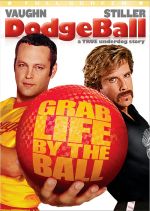
There are two movies I recently 'discovered' when they went into multiple daily airing mode on Movie Central. One is 'Dodgeball'...
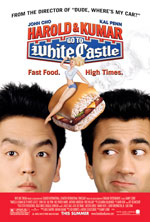
The other is 'Harold and Kumar Go To White Castle'...
Now by discovered I mean I had no interest in seeing them when they were released, and even upon hearing decent things still didn't rent them, but now find it difficult to not change the channel when they come on.
What is it that makes a great comedy? Or more specifically, a comedy that holds up under repeated viewings. One that you WANT to watch over and over again (this is probably more of a question for the kids...it's kind of a youth thing - 'Napoleon Dynamite' was a recent example).
In my younger days, it was the big three - 'Caddyshack', Animal House', and 'The Blues Brothers'. Except back then, pre-VHS video, it was about hoping for them to show up on the bill at the local drive-in (mommy, what's a drive-in? or vhs for that matter?). My buddies and I would sit through 'Staying Alive' with Travolta (ugh) if any of the above were the second flick. The piece de resistance was all three on a Labour Day weekend triple bill. Classic.
Other 'must see's' included Woody Allen's 'Play It Again Sam', 'Bananas', and 'Take The Money And Run' ("I have a gub.")...they'd show up occasionally on late night TV. But we'd stay up for them. No. Matter. What.
In fact, I had to wrangle sleepovers to watch them until I was almost 16 years old because we didn't have a television in our home. "Gape". I know, my parents were funny that way. Theatre folk. Old school. And I guess we did have a tv, but it was a 12 inch black&white with a coat hanger for an aerial and you turned to the other channel with pliers (yes, two channels), so it didn't really count. And it only came out (yes, it lived in the back of a closet) on special occasions like the first walk on the moon, the Oscars, and the Canada/Russia hockey series (or my dad and I would sneak it out and watch Rockford Files when my mom was out).
So, I slept over at friends houses a lot. That was my only way to stay somewhat connected to the other kids and what they were all talking about...TV-wise. I know...cry me a river.
Back to more recent comedies...I enjoyed 'Wedding Crashers' and '40 Year Old Virgin', but don't find myself getting drawn into watching them again when they show up on the Movie Channel. At least not in the same way I do with 'Dodgeball' and 'White Castle' (same thing happened with 'Old School')
Why is that? I already know the jokes. I know what happens. Know why it happens. So how come?
'White Castle' is basically a road movie with a stoner element - a simple quest (they must get to White Castle) constantly interrupted by a series of bad luck and wrong turns and unfortunate incidents. Sort of a Blues Brothers without the songs. In some ways, it's just a bunch of funny sketches strung together, but it still holds up remarkably well. And all the characters they encounter along the way are memorable, especially Neil Patrick Harris (Doogie Hauser) playing himself hitchhiking:
Neil Patrick Harris: It's a fucking sausage fest in here, bros. Let's get some poontang, then we'll go to White Castle. Kumar: No, Neil, you don't understand. We've been craving these burgers all night. Neil Patrick Harris: Yeah, I've been craving burgers, too. Furburgers.
'Dodgeball' is basically an underdog flick, 'Animal House' with some 'Rocky' thrown in, where the little guys at the loser gym take on the Globo-Gym Goliath and emerge victorious.
And all the characters are memorable as well, especially Ben Stiller as White Goodman (what a name) and Gary Cole as sportscaster Cotton McKnight:
McKnight: "Ladies and gentlemen, I have been to the Great Wall of China, I have seen the Pyramids of Egypt, I've even witnessed a grown man satisfy a camel. But never in all my years as a sportscaster have I witnessed something as improbable, as impossible, as what we've witnessed here today!"
But what gives both films that repeat viewability factor? Why these movies and not others? Both are about average Joe's tired of being stepped on and pushed around and deciding to push back. The writing is tight, sharp, and very funny...everyone's motivations are clear and simple with constant reversals and logical obstacles...and the direction is impeccable (there's a real art to letting funny just be funny and not trying to 'make it or direct it' funny). Finally, at their core, both movies have a lot of heart.
And...so what.
Maybe it's wanting to feel that good feeling again felt when I first watched it. Maybe it's the neverending quest to want to laugh or to be made to laugh...because laughing makes us feel better. Maybe it's just a guy thing (though women do show a tendancy to repeat view certain romantic comedies). Or maybe it's a purely personal thing that can't be analyzed or figured out. My 'Old School' is your 'American Pie', or 'Duck Soup'. I don't know.
But 'Dodgeball' and 'Harold and Kumar Go To White Castle'? Who'd a thunk it.
Not me.
SONG&ARTIST? - "Some day somebody's gonna make you Want to turn around and say goodbye Until then baby are you going to let them Hold you down and make you cry Don't you know? Don't you know things can change Things'll go your way If you hold on for one more day..."
...so as the film world mourns Altman's passing and the rest worry about Michael Richards SNAFU or wonder about Tom and Katie's wedding - Dix comes in from the opposite direction and puts out a followup to the Likeability post...
What tv shows do you watch for a particular actor or actresses' likeabilty...or more blatantly, the 'hotness' factor?
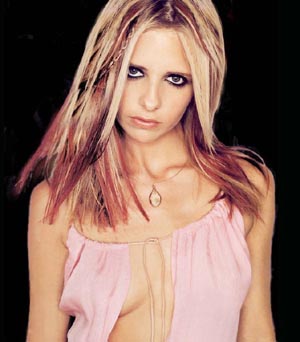
For a long time, it was Sarah M. Gellar for me - even though I enjoyed and admired the Buffy series, there was also her kickass yum factor me likey.
And on the male side, I can admit now had an unexplainable thing for David Duchovny on the X File's...
More recently, House's Hugh Laurie most definitely turns my cranky with his handsome irritability factor.
And as for the ladies, Earle's Jaime Pressley is belle-iscious and Huff's Paget Brewster encouraged me to tune in...and watch. And I like to watch (now she's on Criminal Minds, much to Jutratest's chagrin - unattractive?).
Now it hasn't hurt that a lot of these series are also good shows. But is it a coincidence?
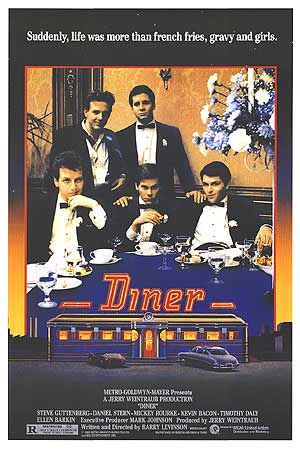
One of my fav flicks of all time is 'Diner' - Barry Levinson's directorial debut in 1982. He also wrote it.
It told the story of a group of college-age buddies who struggle with their imminent passage into adulthood in 1959 Baltimore. Funny yet heart-warming (I'm sure even I teared up a bit at the end), it was filled with memorable dialogue like:
"We all know most marriages depend on a firm grasp of football trivia."
"It just pushed the flaps open?" "Ripley's...I know."
"Carol Heathrow. She... is death!"
"Do you ever get the feeling that there's something going on that we don't know about?"
"I'll hit you so hard, I'll kill your whole family."
And of course:
"If you want to talk, you always have the guys at the diner. You don't need a girl if you wanna talk."
And these lines were delivered by a great collection of characters. With great names, and nicknames.
Steve Guttenberg was 'Eddie'....Daniel Stern went by 'Shrevie'...Mickey Rourke hit it out of the park as 'Boogie'....Kevin Bacon scored as 'Fenwick'....Timothy Daly was the straight man and thus just 'Billy'....Ellen Barkin as 'Beth'...Michael Tucker as 'Bagel'....and of course, 'Modell', played by Paul Reiser.
'Bagel'. Sweet.
Part of what made that movie, in my mind, was those names or nicknames. They all fit, and added shading and nuance to the characters and their relationships with each other simply with just one simple word and how it was delivered.
Which got me thinking about some of the nicknames I've had over the years.
Dill Dilliam Pickle (grew out of Dill) Snake (don't ask) Coyote (as in Wile E.) Wilbur Willard
But the most popular two by far have been Dix (right from high school to the present), pretty self evident .... and what yesterdays post reminded me of, and that is the nickname DCD, short for Dark Cloud Dixon. That one evolved from me generally being the mutterer around film sets and writers rooms about 'whether this scene will work' or 'how do we shoot that' or 'are we done yet?' I was a little surprised how quickly it stuck when someone called me that...but it must have seemed appropriate. And I didn't protest too much.
What nickname you give a character can paint them in so many different ways. 'Dill' or 'Pickle' suggests one type of person; 'Dix' or 'Snake' another; and 'DCD' or 'Dark Cloud' someone else altogether - 'Sauve' and 'Wang' something else altogether. Interesting. I'm sure there's a writing tip in there somewhere but I'm too pooped right now to suss it out.
Since most people don't post/comment with their real names this seems a little pointless, but anyone care to share the origin story of their nickname(s)?