Good bits of advice that all writers should take to heart...and a zillion people out there willing to teach it.
There's a lot of 'how to write' books. And some are really good, and some are so yesterday, and some were published yesterday but deserve to be revisited...like Stephen King's 'On Writing'.
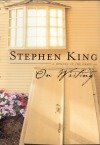
"Life isn't a support-system for art. It's the other way around."
I've been a fan of Mr. King's work for most of my adult life. And only recently realized how much of a profound effect he had on me and my story arenas of choice...
Paranormal/horror/mysteries/creepy/supernatural/things are not as they seem...been there, done that...done it a lot.
"Imagery does not occur on the writer's page; it occurs in the reader's mind."
I remember first crossing paths with King after taking 'The Shining' on a road trip with several high school buddies, and was unable to put it down the entire long weekend.
"Dix, we're shotgunning beers!"
"Shut up I'm reading."
"Dix, there's more girls here than guys!"
"Shut up, I'm reading."
"And the girls are all really drunk!"
"Shut up..."
Anyway, you get the picture.
'The Shining' grabbed me right off the bat and then it drew me in. And it scared the hell out of me. Furthermore, it was written in a style I was not familiar...you know, the ol' hearing/reading someone's thoughts written in italics trick...
The Daddy smiled down at his Son.
....you little brat, I want to bash your stupid head in...
The Son looked up at his Daddy in alarm.
So creepy and yet so cool.
I loved the way he wrote...what he wrote about...how he tended to entertain first and foremost..how he always integrated music and quoted song lyrics constantly (another influence). I read pretty much everything King wrote up until 'Insomnia' - the mid-90's I think -and then my interest in him waned. Or perhaps, my interest in reading in general waned.
"Most of it's pretty good, just take the bad parts out."
"Everything You Need to Know About Writing Successfully - in Ten Minutes" by Stephen King
1. Be talented
This, of course, is the killer. What is talent? We're not talking about good or bad here. People who are published/hired steadily and are paid for what they are writing may be either saints or trollops, but they are clearly reaching a great many someones who want what they have. Ergo, they are communicating. Ergo, they are talented. The biggest part of writing successfully is being talented, and in the context of marketing, the only bad writer is one who doesn't get paid. If you're not talented, you won't succeed. And if you're not succeeding, you should know when to quit.
2. Be neat and observe all rules for proper submission
Type. Format properly. Use a nice heavy white paper, never that erasable onion-skin stuff. If you've marked up your script at all, print another draft.
3. Be self-critical
If you haven't marked up your script a lot, you did a lazy job. Only God gets things right the first time.
4. Remove every extraneous word
You want to preach? Fine. Get a soapbox. You want to write for money? Get to the point. And if you remove all the excess garbage and discover you can't find the point, tear up what you wrote and start all over again . . . or try something new.
5. Never look at a reference book while doing a first draft
You want to write a story? Fine. Put away your dictionary, your encyclopedias, your World Almanac, and your thesaurus. There are no exceptions to this rule. You think you might have misspelled a word? O.K., so here is your choice: either look it up in the dictionary, thereby making sure you have it right - and breaking your train of thought and the writer's trance in the bargain - or just spell it phonetically and correct it later. And if you need to know the largest city in Brazil and you find you don't have it in your head, why not write in Miami, or Cleveland? You can check it ... but later. When you sit down to write, write. Don't do anything else except go to the bathroom, and only do that if it absolutely cannot be put off.
6. Know the markets
Only a dimwit would send a story/script about giant vampire bats surrounding a high school to 'Gilmore Girls'. Only a dimwit would send a tender story/script about a mother and daughter making up their differences on Christmas Eve to 'Masters of Horror'... but people do it all the time. If you write a good story/script, why send it out in an ignorant fashion?
7. Write to entertain
Does this mean you can't write "serious fiction"? It does not. But your serious ideas must always serve your story, not the other way around. I repeat: if you want to preach, get a soapbox.
8. Ask yourself frequently, "Am I having fun?"
The answer needn't always be yes. But if it's always no, it's time for a new project or a new career.
9. Evaluate criticism
Show your work to a number of people. Listen carefully to what they tell you. Smile and nod a lot. Then review what was said very carefully. If most of your critics are telling you the same thing about some facet of your story - a plot twist that doesn't work, a character who rings false, stilted narrative, or half a dozen other possibles - change that facet. It doesn't matter if you really liked that twist of that character; if a lot of people are telling you something is wrong with your script, it is. But if everyone - or even most everyone - is criticizing something different, you can safely disregard what all of them say.
10. If it's bad, kill it
When it comes to people, mercy killing is against the law. When it comes to fiction/screenwriting, it is the law.
(The above excerpts are copyright Stephen King, 1988. For the full article, go to Stephen King's Writing Tips . And here's another article from King over at Wordplay entitled 'Imagery and the Third Eye' which speaks more specifically to writing for film.)
I realize a lot of these tips are like "...no shit, Sherlock", but occasionally seeing them in point form helps them stick.
I have written or co-written a fair number of scripts over the past decade, but they all have been episodes for existing television shows. Or I've written tv series specs. Or I've created bibles and pilots for new tv series that never saw the light of a HMI. Or worked on co-writes of some movies and a mini-series...
But I haven't begun a solo original feature length screenplay in about ten years. Not until recently, that is...
"I don't believe writing is a way of life, but I do believe it can be a way back to life."
Another good bit of advice. Advice I'm finally starting to take to heart as well...
SONG & ARTIST? - "Doctor lawyer beggar man thief,
Philly Joe remarkable looks on in disbelief,
If you want a taste of madness, you'll have to wait in line,
You'll probably see someone you know on heartattack and vine."
SONG & ARTIST? - "And Romeo says hey man gimme a cigarette and they all reach for their pack
And Frankie lights it for him and pats him on the back, and throws a bottle at a milk truck and as it breaks he grabs his nuts
And they all know they could be just like Romeo if they only had the guts..."